
Most UK operators treat Christmas as a November problem
The festive menu gets signed off in late October, the social posts go up around bonfire night, and the phone starts ringing properly in the third week of November. By then a large share of the December diary has already gone elsewhere.
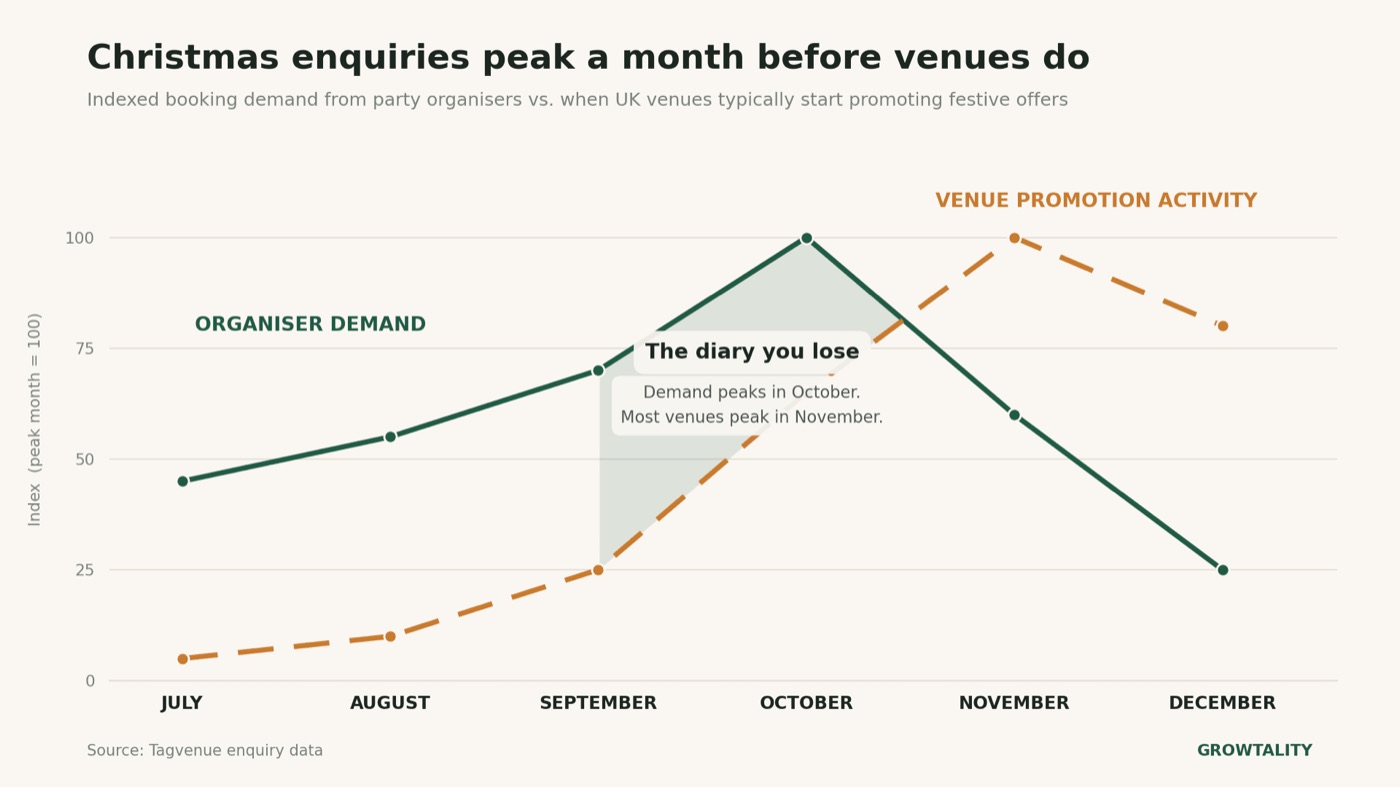
Tagvenue’s booking data puts the first peak in Christmas enquiries in July, with roughly 30% of prime December dates secured by the end of September. October brings the rush: demand jumps 130% as companies that left it late start calling round. (Source: Tagvenue)
Organisers with real budget and a confirmed headcount book early. Venues that open bookings in November compete for what they left behind.
December earns more per cover than any month you’ll trade
Figures from The Oxford Partnership show December 2025 delivered the highest spend per head of the year across UK hospitality, with average dwell time reaching 150 minutes, longer than any other month. (Source: The Oxford Partnership)
The NIQ RSM Hospitality Business Tracker recorded December like-for-like growth of 5.1% for pubs and 0.8% for restaurants. That’s modest on paper, but it was the strongest month of 2025 for both restaurants and bars, in a year when restaurant trading fell year-on-year in ten of eleven months. (Source: NIQ RSM Hospitality Business Tracker)
December pays for January and February. So a 10% shortfall in festive covers hurts far more than 10% suggests, because it comes straight out of the only surplus most sites make all year.
How the December diary actually fills
| Month | What organisers are doing | Share of prime December dates gone |
|---|---|---|
| July | First enquiry peak; corporates lock dates | ~10% |
| August | Shortlisting and quotes | ~20% |
| September | Sign-off | ~30% |
| October | Demand spike, +130% enquiries | ~60% |
| November | Late scramble, midweek only | ~85% |
| December | Walk-ins and cancellations | n/a |
Booking pace based on Tagvenue enquiry data. Thursdays and Fridays clear first; Tuesdays and Wednesdays hold longest.
Demand arrives early, while most venues’ availability is promoted late. A venue that publishes its festive menu on 1 October is already behind a third of the market that has signed.
The deposit gap is still wide, and December is where it hurts
No-shows cost more in December. A Tuesday no-show costs you a table. A festive no-show costs you a table you turned three other enquiries away for, plus the stock you bought and the staff you rota’d.
Even so, 38% of UK restaurants still have no deposit system. (Source: ResDiary) Owners usually worry about putting guests off, yet the same research found 62% of diners are happy to give card details to secure a booking.
OpenTable reports that deposits cut no-shows by an average of 57%, and that restaurants selling prepaid festive experiences average 30% higher spend per person than those that don’t. (Source: OpenTable)
| Policy | Typical December no-show rate | Effect on booking volume |
|---|---|---|
| Confirmation email only | 15 to 20% | Highest volume, least certain |
| SMS reminder sequence | 8 to 12% | No drop |
| £10 to £20 per head deposit | 4 to 7% | Slight drop, better quality |
| Full prepay (set menu) | Under 5% | Lowest volume, highest spend |
Most operators do best with a threshold: no deposit under six covers, £10 per head above six, and full prepay for private hire and Christmas Day.
Pre-orders protect your margin
A party of 24 arriving without a pre-order leaves the kitchen guessing on the busiest night of the month. The same party pre-ordered ten days out gives the kitchen a prep list.
Chains have standardised on this. All Bar One requires a £10 per person deposit on festive set menus, with pre-orders due seven days ahead. (Source: All Bar One) Independents tend to chase pre-orders in the final 48 hours and lose the margin benefit.
Price the menu now. Outside London, the average per-head Christmas party budget was £95.44 in 2025, and actual spend came to £82.46. (Source: Office Christmas Party Market Report 2025) That £13 gap is where drinks packages belong.
The timeline
| Window | Priority actions |
|---|---|
| Early September | Menu costed and published; deposit policy live; booking page open |
| Mid September | Email last year’s December bookers before they shop around |
| Late September | Corporate outreach to local offices; private hire minimums set |
| October | Paid and organic push at peak demand; capacity caps by session |
| Early November | Pre-order chase automated; stock and rota locked to confirmed covers |
| Late November | Waitlist live; reconfirm every booking over eight |
| December | Trade. Capture guest data at every table |
That last line matters more than the rest combined. December brings you more new guests in a shorter time than any other month, and almost none of them get captured. A festive booking with no email address is a one-night sale. One with marketing consent is a guest you can sell to in January, when the room is empty and reaching people is cheap.
So the September work pays off well after Christmas, in what December leaves you with for February.
Set up your festive diary before the October rush
Growtality gives UK restaurants deposit-backed bookings with thresholds by party size, automated pre-order reminders, and a guest CRM that captures every December cover so you have a list to market to in January. It all runs on your own site, with no commission per head.
Questions owners ask
When should restaurants start taking Christmas bookings?
Early September. Corporate organisers start enquiring in July and sign off in September, so a large share of prime December dates is gone before most restaurants start promoting in November. Publish the festive menu, deposit policy and booking page in early September.
Should restaurants take deposits for Christmas parties?
Yes. A festive no-show costs more than a normal one: you turned other enquiries away for that table and bought stock and rota'd staff for it. Deposits with thresholds by party size protect the busiest month of the year.
Why ask Christmas parties to pre-order?
A large party without a pre-order leaves the kitchen guessing on its busiest night. Pre-orders collected about ten days ahead turn the booking into a prep list, cut waste and speed up service.