
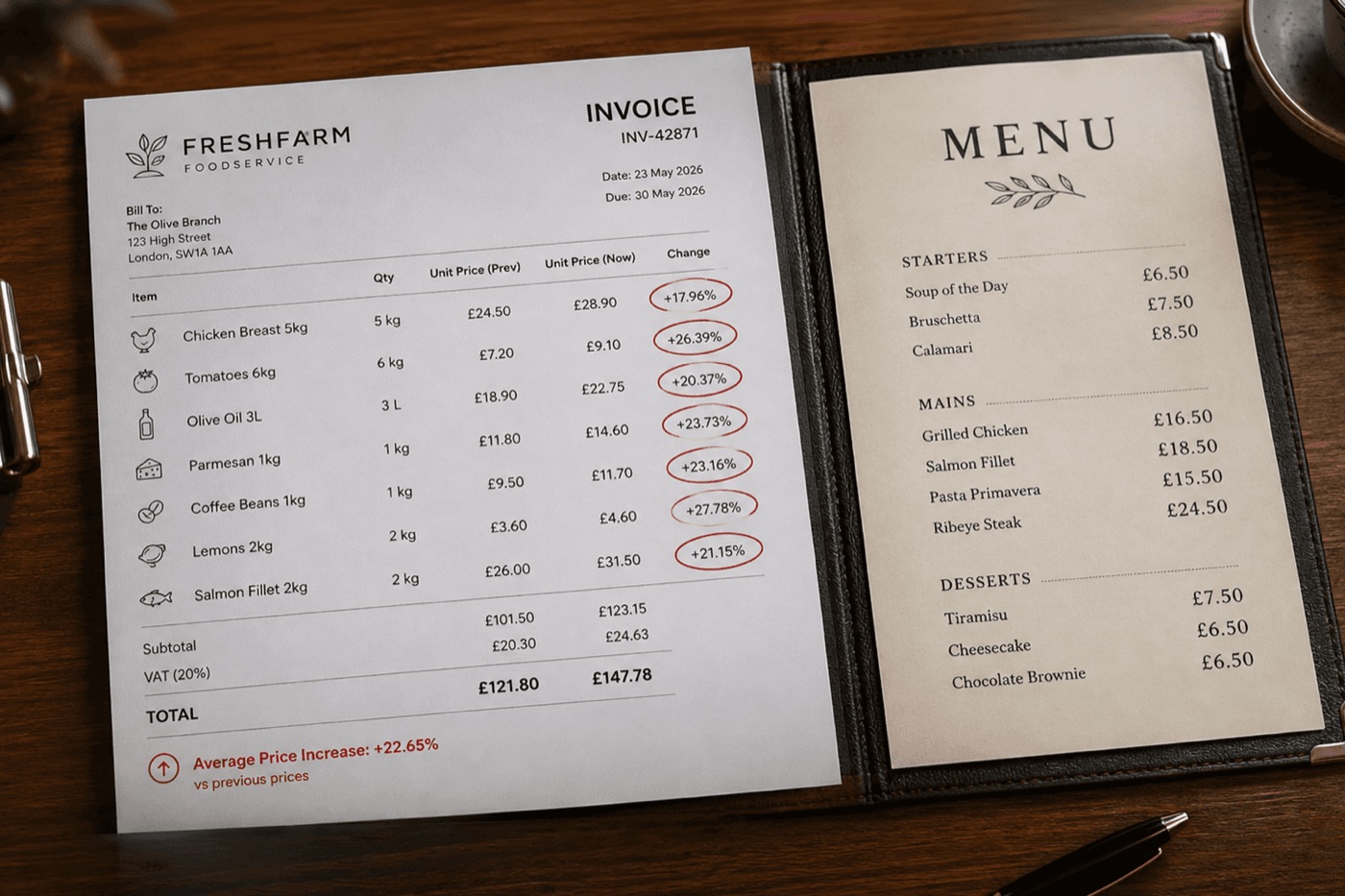
A 60-seat casual-dining spot in the Midwest ran the same menu, at the same prices, from January to December last year. On paper nothing changed. But its fryer oil cost climbed 18% between Q1 and Q3, in line with the 18.2% year-over-year jump in producer prices for fats and oils (Source: National Restaurant Association), and its chicken thigh price rose from $2.10 a pound to $2.55. Nobody adjusted a single price. By the time the owner pulled a P&L in November, the fried chicken sandwich that used to carry a 68% margin was down to 54%. It was still the best-selling item on the menu, and it was losing the restaurant money on every order.
That wasn’t bad luck. It’s what happens by default when a menu’s prices stay fixed while food costs keep moving.
The numbers behind the squeeze
Industry-wide data shows the same squeeze again and again:
- Food costs are roughly 34 to 35% higher than before the pandemic, and 82% of operators said their food costs were higher in 2025 than in 2024. (Source: National Restaurant Association)
- Total restaurant operating expenses are up about 36% since 2019, and labour costs alone have climbed 39% over the same period. (Source: National Restaurant Association)
- Menu prices have risen roughly 27 to 31% since 2019, but operators needed a full 31% increase just to keep a 5% profit margin at pre-pandemic levels. Most fell short: 42% of operators reported being unprofitable in 2025. (Source: National Restaurant Association)
- 95% of full-service and 94% of limited-service operators now name food costs as their top business concern.
- Costs don’t move evenly across the menu. In the twelve months to July 2025, producer prices for unprocessed finfish jumped 44.8%, fats and oils rose 18.2%, and beef and veal climbed 7.8%, while eggs fell 79% and pork dropped nearly 15%. A menu priced on one average misses all of that, and looking at each dish catches it.
- The “moderate” headline numbers add up quickly too. Full-service menu prices grew 4.9% year-over-year as of December 2025, and restaurant prices overall rose 3.9% year-over-year in one recent month. On a $20 entrée that’s about 80 cents, and across 200 covers a night it comes to roughly $5,000 a month in extra guest spend that you only capture if you track margin and price for it. (Source: BLS data via Barmetrix)
Across all of these, input costs and total expenses have risen by double digits over several years, while a typical menu update only catches up on a handful of items. Margin wears away in that gap, and nobody notices until the annual review.
What flat pricing actually costs, dish by dish
Here’s that gap on paper for a single dish: a grilled chicken sandwich priced at $14.95 and left unchanged for twelve months. The ingredient changes below are illustrative. They’re based on the fats-and-oils and protein inflation rates above, not taken from one restaurant’s books:
| 12 months ago | Today | |
|---|---|---|
| Menu price | $14.95 | $14.95 |
| Chicken thigh (6 oz) | $0.79 | $0.96 |
| Cooking oil (portion) | $0.18 | $0.22 |
| Bun + produce | $1.10 | $1.24 |
| Sauce + packaging | $0.35 | $0.38 |
| Total food cost | $2.42 | $2.80 |
| Food cost % | 16.2% | 18.7% |
| Gross margin | $12.53 (83.8%) | $12.15 (81.3%) |
A 2.5-point margin swing on one item looks small until you multiply it across 40 dishes and a few hundred covers a night. On a menu doing 300 covers a day, a similar drift across the top 10 sellers can cost $1,500-$2,500 a month in margin. It never shows up as a “problem” on the P&L, just as a slightly worse bottom line that’s hard to trace back to any one decision. That fits the industry-wide picture: food and non-alcohol beverage costs sat at a median 32.0-32.4% of sales in 2024, so most operators run close enough to the line that a two- or three-point drift on high-volume items decides whether a quarter is healthy or flat. (Source: National Restaurant Association Restaurant Operations Data Abstract)
Low-risk ways to start pricing dynamically
Dynamic pricing in a restaurant doesn’t have to mean surge pricing or anything that feels like an airline fare. A few starting points cause little friction, both in practice and in what operators already report doing in surveys:
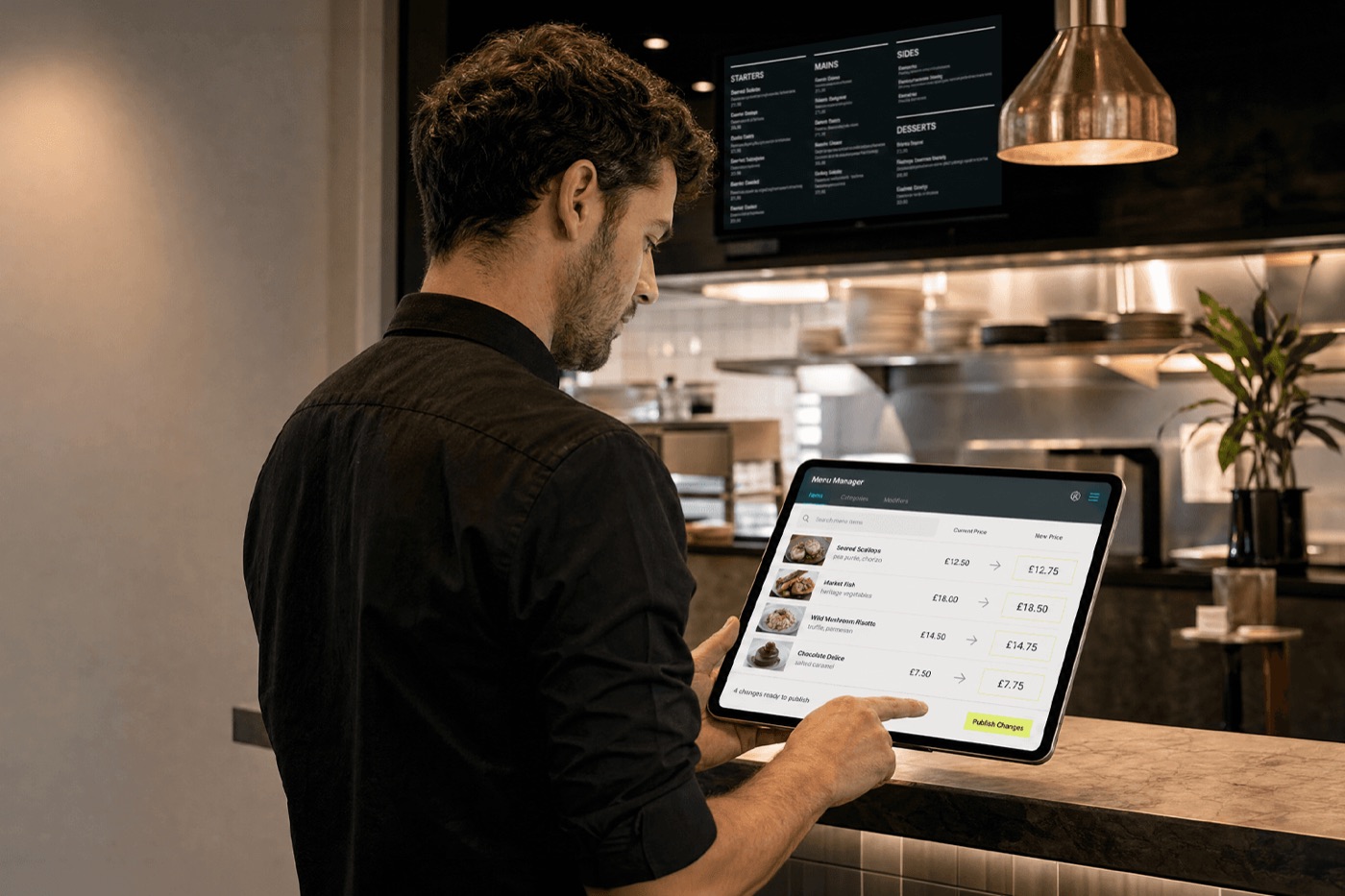
- Seasonal menu refreshes. Instead of one price update a year, reprice 15-20 core items every quarter, timed to a seasonal menu change you’re making anyway. The restaurant then absorbs cost swings in smaller, less noticeable steps: a regular reads a $0.50 change four times a year very differently from a sudden $2.00 jump in month twelve. The data supports this. Menu-price growth has slowed to roughly 0.2-0.4% month over month as more operators make smaller, more frequent changes instead of one large annual correction, and each change is small enough that most guests don’t register it as an “increase” at all. (Source: DoorDash 2025 menu-price analysis)
- Weekday and weekend pricing works well on items with real demand, such as a Friday-night steak special or a weekend brunch dish with a hard reservation cap. A $1-$2 premium on a Saturday-only version of a dish rarely draws complaints, because guests already expect weekend specials to be priced differently.
- Limited-time pricing on slow sellers does the opposite job and uses price to move stock. A modest discount of 10-15% for two weeks on a dish that sells slowly can shift demand toward ingredients close to their use-by date or overstocked, so you protect margin by cutting waste instead of raising prices elsewhere. Operators already do this: 45% of restaurants surveyed said time-specific discounts are one of their main ways of protecting margin as costs rise, alongside deals (46%) and extra marketing (47%). (Source: Toast industry survey)
The trust risk is real, and the research on managing it is surprising
Handled clumsily, none of this works, and guests notice price changes far more than operators might hope:
- 82% of U.S. consumers said they’d noticed restaurant prices rising noticeably over the past year, and only 28% said they felt current prices were fair. (Source: YouGov)
- 37% said they were dining out less as a direct result, rising to 44% among lower-income households, and 69% of that group named price increases as the reason rather than general economic pressure. (Source: YouGov)
- 72% of diners believe restaurants are too expensive, according to a study led by Cornell University’s Sherri Kimes.
The surprising part comes from that same Cornell-affiliated research, an eye-tracking study of 358 participants. Explaining a price increase on the menu, the receipt or at checkout had almost no measurable effect on guest loyalty or spending. Diners’ eyes went straight to the dish and the price and mostly skipped the explanation next to it. Guests rated a restaurant as slightly “fairer” when a note was there, but it didn’t change what or how much they ordered. The researchers concluded that guests judge a price by whether the experience feels worth it, whatever the menu says to justify the number. (Source: Revenue Management Solutions / Cornell University)
Communication still helps, but where and how you do it matters more:
- A short note on sourcing or season (“Gulf shrimp, market price,” “seasonal citrus, subject to availability”) does help guests accept that a changing price is tied to something real. Roughly 70% of diners said they prefer restaurants to tell them in advance when prices go up, even if it doesn’t change their order. (Source: Toast survey)
- Gradual, frequent changes go down better than sudden jumps. Three $0.50 increases spread across a year land more softly than one $1.50 correction in December, even though the total is the same, and the slowing monthly growth in menu prices suggests more operators are already moving this way.
In practice, skip the defensive paragraph on the menu explaining every price, and do keep moving prices in small, regular steps instead of one uncomfortable correction a year.
Catching the drift before it becomes a quarterly surprise
The chicken sandwich above is the kind of erosion a monthly sales report hides and a margin report shows straight away, if someone builds one dish by dish every week. Growtality’s platform is built for this. Automated margin tracking flags when a dish’s food cost percentage creeps past a threshold you set, before you’ve spent a quarter selling underpriced best-sellers. Instead of finding the problem in a year-end P&L review, you get an alert in the week ingredient costs move, while there’s still time for a small, easy-to-explain change instead of a big, uncomfortable one.
Try Growtality free and see which of your dishes are losing margin right now.
Questions owners ask
Why is static menu pricing costing restaurants money?
Food costs are roughly 34 to 35% higher than before the pandemic and keep moving, so a menu priced once and left alone slowly loses margin on every plate, often without showing up in sales reports.
What is dynamic pricing for restaurants?
Adjusting prices in small, considered steps as costs and demand change: refreshing prices on core items each quarter, a small premium on genuinely high-demand weekend dishes, or a limited-time discount to move slow sellers. It doesn't have to mean airline-style surge pricing.
Will guests notice if restaurants change prices?
Yes. 82% of US consumers said they'd noticed restaurant prices rising over the past year, so changes need to be gradual, clearly explained and tied to value.