
For most restaurant owners, technology in 2026 has little to do with robots behind the counter. The questions are much simpler:
- Can this bring customers back?
- Can it save my team time?
- Can it reduce waste?
- Can it increase the value of each order?
- Can it help me keep more of the money I make?
Those questions are shaping restaurant technology this year.
The U.S. restaurant industry is projected to reach $1.55 trillion in sales this year, while operators keep dealing with uneven traffic and rising costs. The National Restaurant Association says restaurants are turning to digital ordering, automation and data analytics to work more efficiently and build stronger guest relationships (National Restaurant Association, State of the Restaurant Industry 2026).
Meanwhile, diners are harder to win and easier to lose. 45% of diners say their favorite restaurant chain changed in the past year, up from 33% in 2025.
Here’s what’s changing inside restaurants.
1. First-party ordering is becoming a growth channel
Third-party delivery isn’t going anywhere. Restaurants still need marketplaces, because they reach people who might never have found them otherwise.
The trouble is that every order placed somewhere else makes it harder to build a direct relationship with that customer, and the economics are tough too. DoorDash currently lists delivery commission rates of 15%, 25% or 30%, depending on the merchant plan (DoorDash, Merchant Pricing).
So restaurants are putting more effort into:
- Their own ordering websites
- Branded apps
- Direct pickup
- Customer databases
- Loyalty programs
- SMS and email marketing
- Personalized offers
You don’t have to pick between third-party and first-party. Use marketplaces to get discovered, then give customers a good enough reason to order directly next time. The marketplace introduces the customer, and your own technology helps you keep them.
2. Frictionless ordering and payments
Customers don’t care what POS a restaurant uses, which API connects the loyalty program, or whether the ordering system runs in the cloud. They care whether it works.
They want to:
- Find the menu quickly
- Understand what they’re ordering
- Customize it without confusion
- Pay without unnecessary steps
- Know when their order will be ready
- Receive what they actually ordered
That sounds basic, but plenty of restaurants still get it wrong.
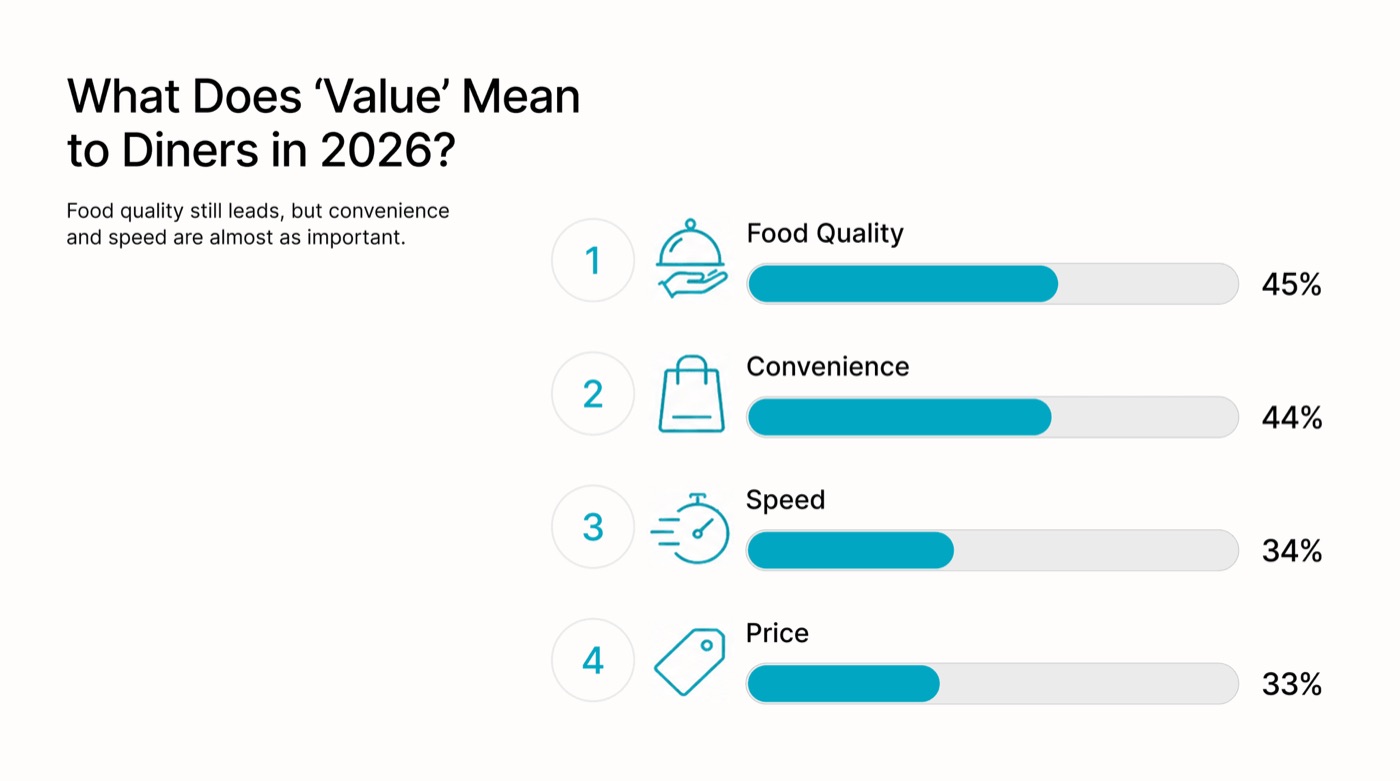
Tillster’s 2026 research found that diners rank food quality (45%), convenience (44%) and speed (34%) as their top three factors when choosing where to eat. Price came fourth at 33% (Tillster, Restaurant Technology Trends 2026).
So technology is now part of the dining experience. A slow website can lose an order, a confusing kiosk can lose a customer, and a payment process with too many steps can lose a sale. Good restaurant technology should be almost invisible; if the customer notices how complicated it is, something has probably gone wrong.
3. Loyalty is moving beyond discounts
For years, restaurant loyalty meant buying, collecting points, getting a discount and repeating. That’s changing, because restaurants now know far more about their customers:
- What they order
- How often they visit
- When they usually order
- How much they spend
- Whether they prefer delivery or pickup
- When they stopped coming back
With that information, loyalty becomes less about handing out discounts and more about understanding how guests behave.
Toast’s 2026 data found that up to 50% of restaurant order volume can come from just 7% of guests. Its loyalty data also found that moving a guest into a loyalty program can raise return rates from a 7% baseline to nearly 30% (Toast, The Regulars Report 2026).
That’s a good reason to stop treating every customer the same. Instead of sending everyone “20% OFF THIS WEEKEND!”, a restaurant can ask:
- Who hasn’t visited recently?
- Who always orders lunch?
- Who spends more when they visit?
- Who responds to specific offers?
- Who is close to becoming a regular?
The aim is to give customers a better reason to come back, without giving away more food.
4. Kiosks are becoming a sales channel
Kiosks started with an obvious promise: customers can order without waiting for a cashier. The bigger opportunity is what the screen can do while they order:
- Recommend add-ons
- Highlight popular combinations
- Make customization easier
- Connect loyalty accounts
- Remember customer preferences
- Present promotions at the right moment
Used that way, a kiosk earns money as well as saving labour.
Badly designed technology creates work, though. 2026 research found that 31% of diners cited confusing interfaces as a problem with kiosks, and 23% were frustrated by trouble redeeming loyalty rewards on-site.
So before installing kiosks, ask whether they’ll make ordering easier than it is now. If they won’t, the screen isn’t solving much.
5. Restaurant technology is becoming more connected
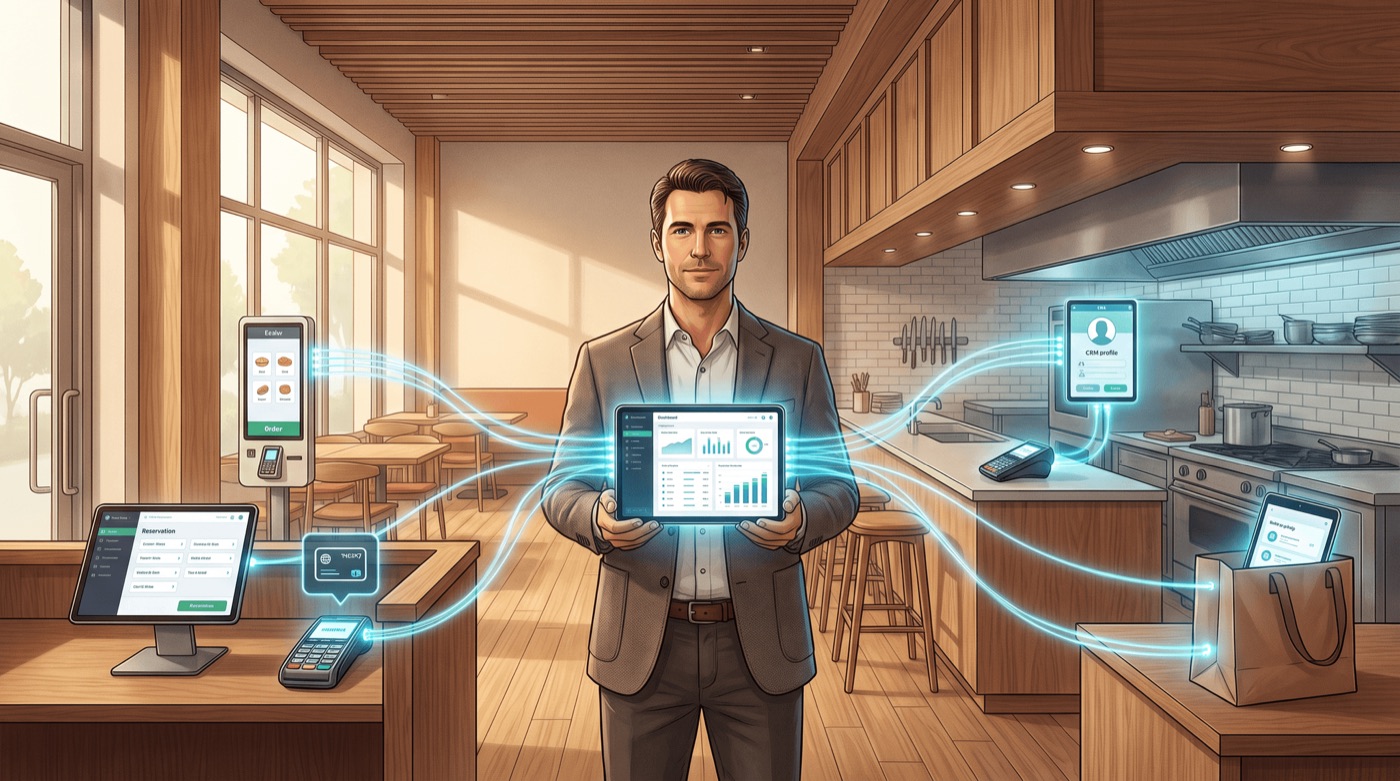
You can have five excellent software products and still have a terrible setup if they don’t talk to each other, and owners don’t always notice this straight away.
A restaurant might use:
- One system for POS
- Another for online ordering
- Another for reservations
- Another for loyalty
- Another for CRM
- Another for delivery
- Another for marketing
- Another for inventory
Now imagine changing a menu price. Someone has to make sure it’s right everywhere. Or a customer earns loyalty points online and then can’t use them in-store.
Connected, composable systems fix this by sharing customer, menu, order and operational data instead of keeping it in separate silos. For restaurant groups, that means less duplicated work, cleaner data and a more consistent experience for customers, which is what a platform like Growtality is built for.
6. AI is moving into the parts of the restaurant that need it
The useful question about AI is where people spend time on repetitive work that software could do better, more than where AI could be added. That might be:
- Forecasting demand
- Managing inventory
- Predicting staffing requirements
- Identifying unusual purchasing patterns
- Segmenting customers
- Creating marketing campaigns
- Handling routine customer questions
- Supporting phone orders
Deloitte found that 82% of restaurant executives surveyed planned to increase AI investment, with customer experience, operations and loyalty among the main areas they expected to benefit.
Readiness lags behind, though. Less than half of Deloitte’s respondents said their organizations were ready for AI across strategy, technology infrastructure, operations, governance and talent (Deloitte Insights, How AI Is Revolutionizing Restaurants).
So adding AI on top of messy systems probably won’t help. Get clean data first, pick a clear problem second, and bring in AI third.
7. Voice ordering and personalization are getting more practical
The last change is at the customer-facing end. Voice technology is appearing in drive-thrus, phone ordering and customer service, and restaurant websites, apps, kiosks and digital menus are becoming more personalized.
The experience matters more than the technology. A customer shouldn’t be thinking that they’re talking to an AI system. They should simply feel that this restaurant gets what they need.
That could mean remembering a previous order, showing a relevant recommendation, answering a simple phone question without putting someone on hold, or helping a customer order when no staff are available. Technology is useful when it removes a small annoyance from the customer’s day, and those small annoyances add up.
The real restaurant technology trend of 2026
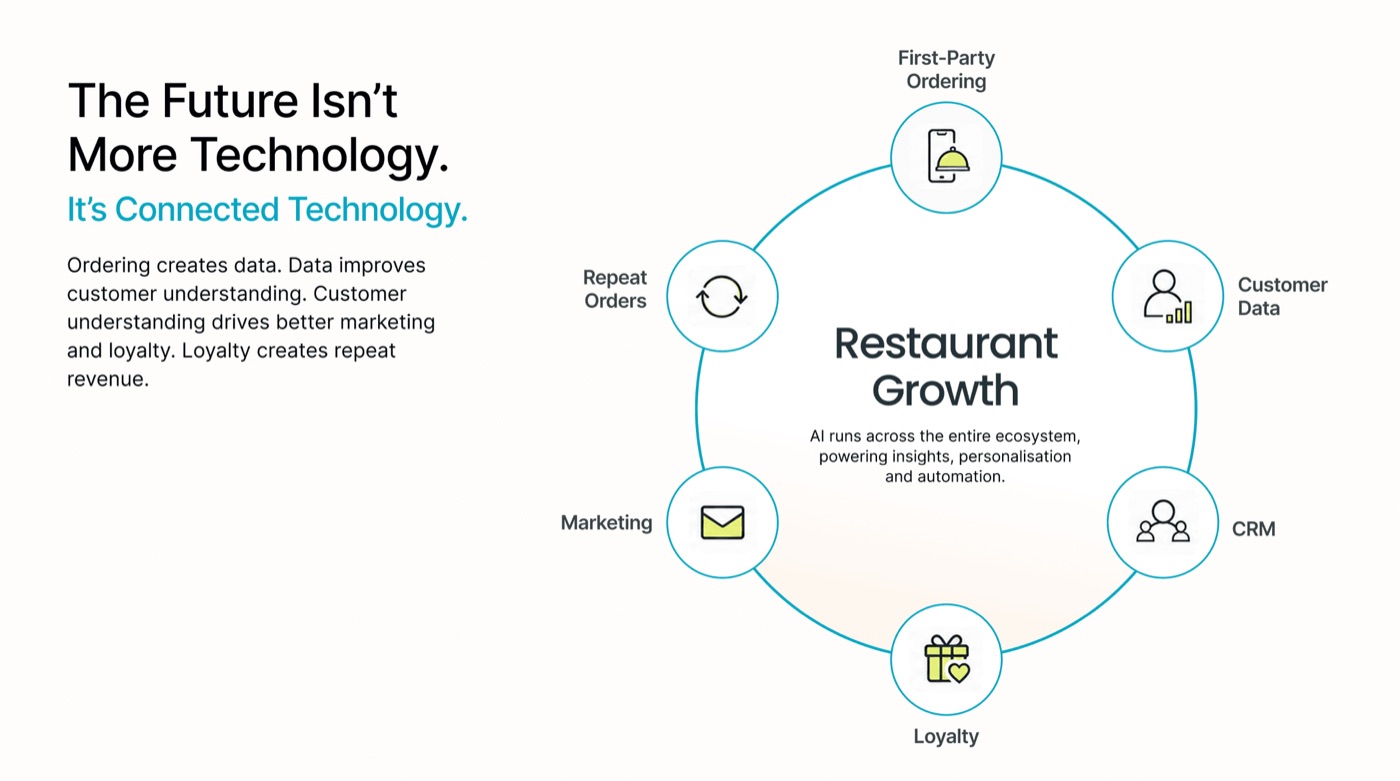
Taken together, the seven trends point to one shift: restaurants are trying to make their software work together, rather than buying more of it.
A customer places an order, and that order creates data about them. The restaurant uses it to improve loyalty, loyalty and marketing bring the customer back, and the next order adds more to what the restaurant knows. Each step feeds the next.
What restaurant owners should take away
You don’t need every new technology on the market. Start with the unglamorous basics:
- Make ordering easy.
- Make payments simple.
- Build a direct customer relationship.
- Know who your regulars are.
- Connect your systems.
- Automate repetitive work.
- Then look at where AI can genuinely help.
The restaurant of the future probably won’t be the one with the most technology. It’ll be the one where the technology stays out of the customer’s way while helping the business make better decisions behind the scenes.
Restaurants used to ask what new technology they could use. In 2026 the better question is which technology actually makes the restaurant better.
Questions owners ask
What are the biggest restaurant technology trends in 2026?
First-party ordering, frictionless ordering and payments, loyalty beyond discounts, smarter kiosks, connected systems, practical AI for repetitive tasks, and voice ordering with personalisation.
Why does first-party ordering matter to restaurants?
Every order placed on a marketplace carries commission and leaves the customer relationship with the platform. Orders on the restaurant's own channel keep the margin and the guest data.
What's the real restaurant technology trend of 2026?
Connection. Restaurants want their ordering, bookings, guest data and marketing to work together, so one order informs everything that follows, rather than simply buying more software.